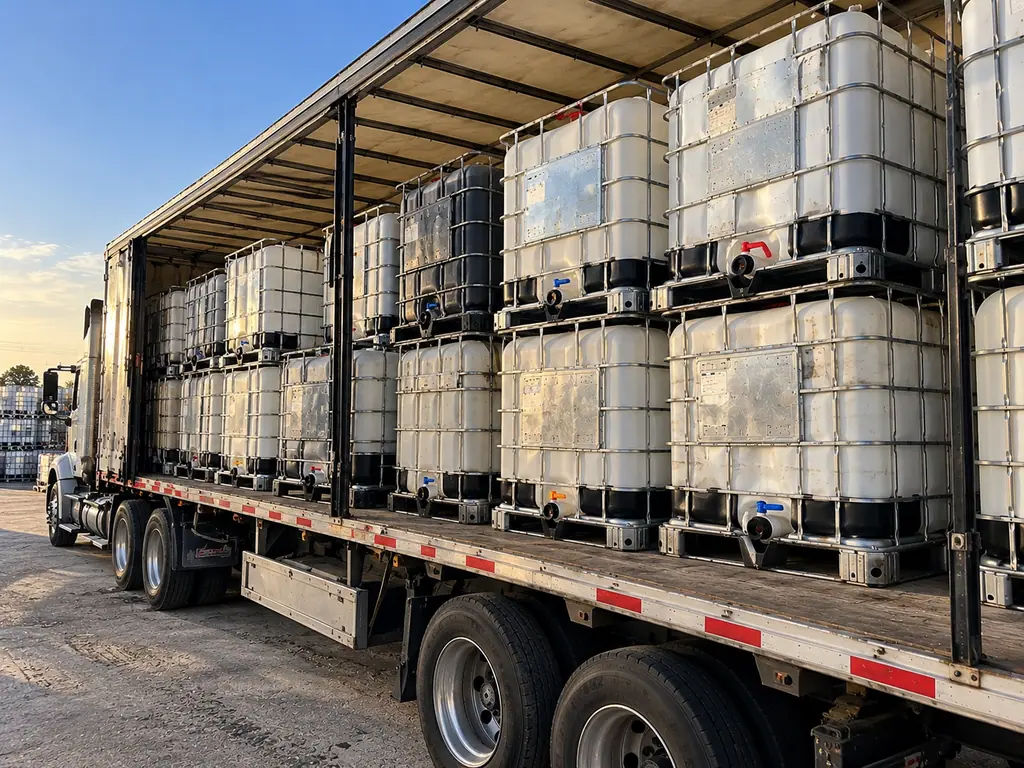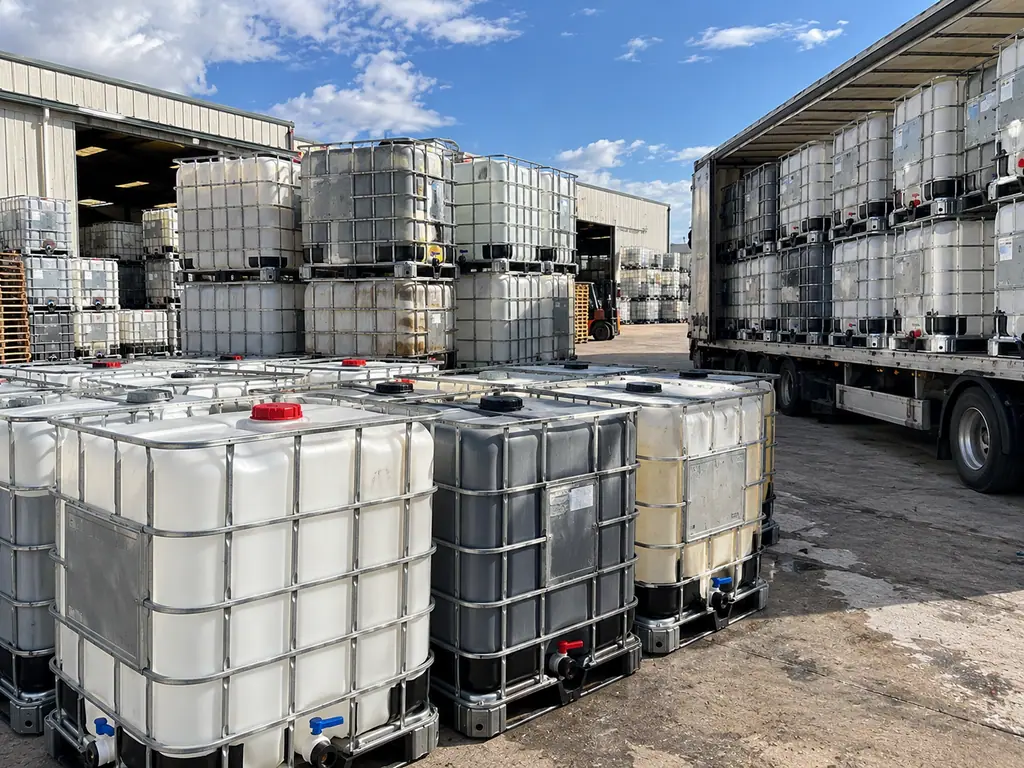
This article is the long-form version of our stacking and storage chapter. If you only read one paragraph, read this one: the cage carries the stack, not the bottle, so the condition of the lower cage decides whether the whole column is safe.
The three rules
- Never stack a filled tote in transit. Not ours, not anyone’s.
- Never stack on a damaged cage — one bowed tube compromises the column.
- Never stack across different formats or pallet types.
Why filled stacks fail in transit
A filled bottle is a flexible membrane holding a tonne of liquid. On the road that liquid moves, the bottle bulges against the cage, and the geometry that made the stack stable at rest changes continuously. Add strap tension working on the lower cage and you have a column that was fine in the yard and is not fine at 60 mph on a frost-heaved road.
Empty cages are rigid and predictable, which is why empties stack and fills do not.
What we do in our own yard
| Situation | Our limit | Note |
|---|---|---|
| Empty, sound cages, static | 3 high | Wind loading on the top unit is the real limit |
| Empty, in transit | 2 high, strapped | With corner board under the straps |
| Filled, static, level concrete | 2 high | Watch for bottle creep over weeks |
| Filled, in transit | Never | No exceptions, regardless of nameplate |
| In pallet racking | 1 per bay | The rack rating governs, not the tote |
| Mixed formats or pallet types | Never | Feet do not land on the load path |
Bottle fatigue is a real, slow failure
HDPE creeps under sustained load. A bottle that has carried another filled tote on top of it for six months will show a permanent bulge at the shoulders, and that bulge is a thinned wall. It will not fail dramatically; it will weep at a seam one morning. If you must double-stack filled totes statically, rotate which unit is on the bottom.
UV, heat and cold
- UV. Bare natural HDPE yellows, clouds and embrittles over several summers. A cover roughly doubles bottle life.
- Thermal breathing. A sealed bottle in full sun pressurises by day and goes into vacuum at night. Over a season that deforms the walls. Fit a gasketed vent plug.
- Freeze. Water expands about 9%. Two-thirds full is the safe winter line for outdoor storage, and some products separate or crystallise irreversibly well above freezing.
Securement, briefly
Our drivers strap in pairs across the cage frame, never over the bottle, with corner board under every strap. Straps over a bare bottle will cut into it under road vibration. If you load your own trailer, do the same.
Siting checklist
- Level, firm ground rated for the filled weight
- Fork or pallet-jack access on at least one side
- Out of vehicle traffic, or behind a bollard
- Secondary containment where the product or local rules require it
- Outlet reachable without crawling under the cage
- Shade or cover if it will live outdoors for years