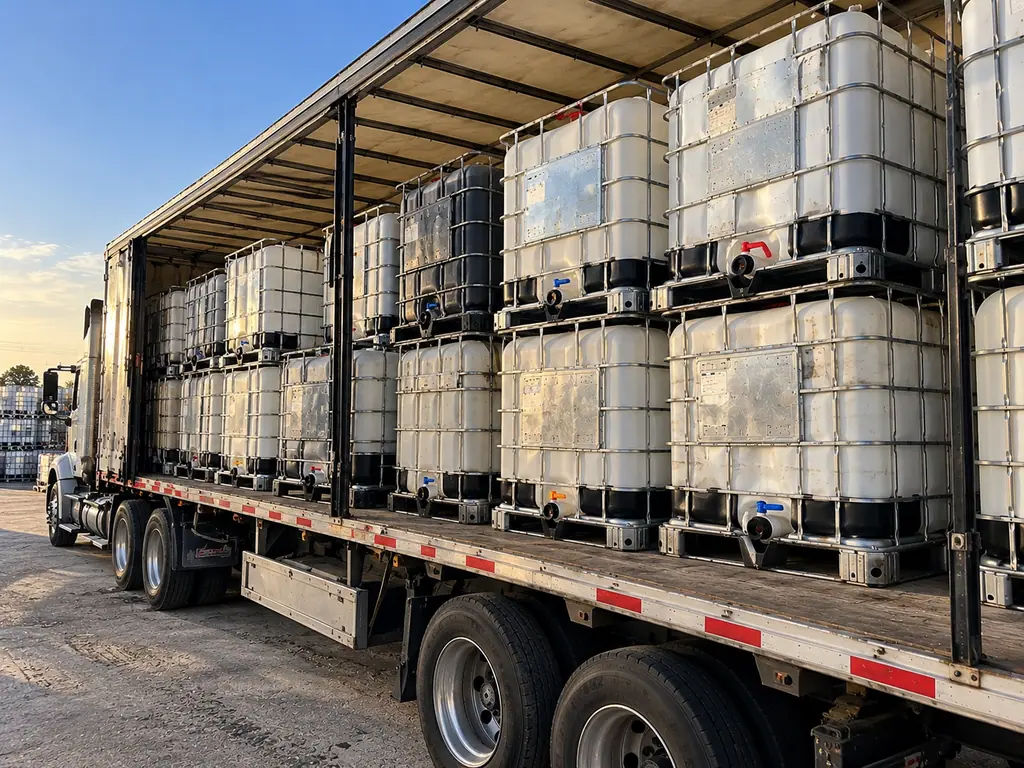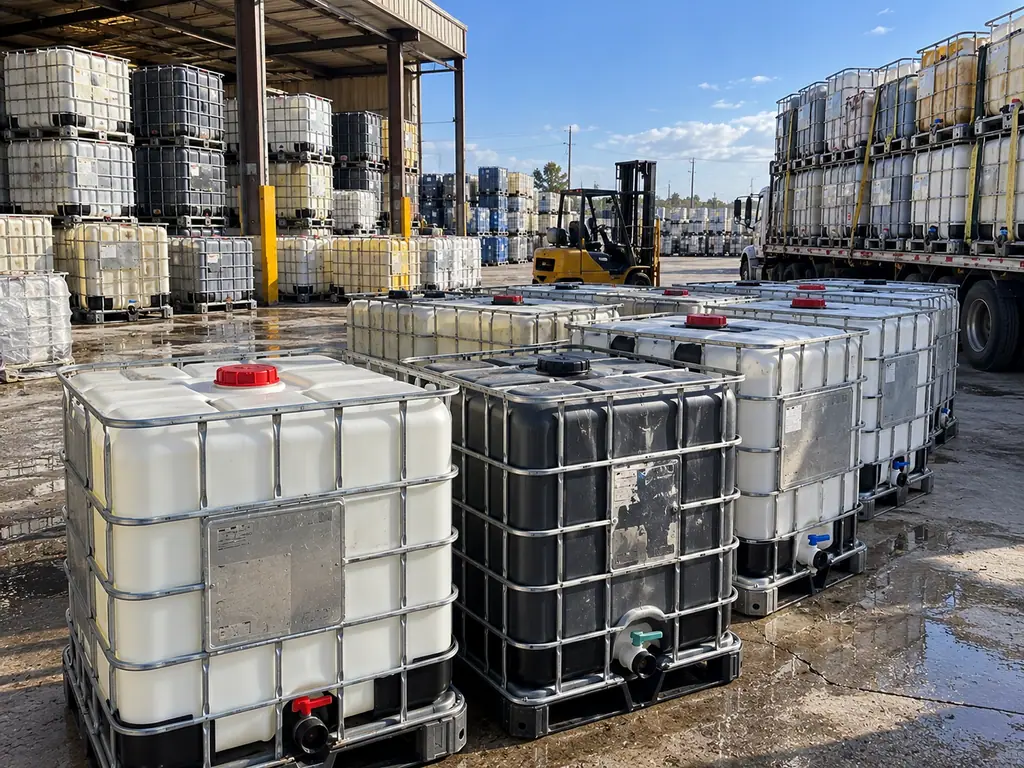
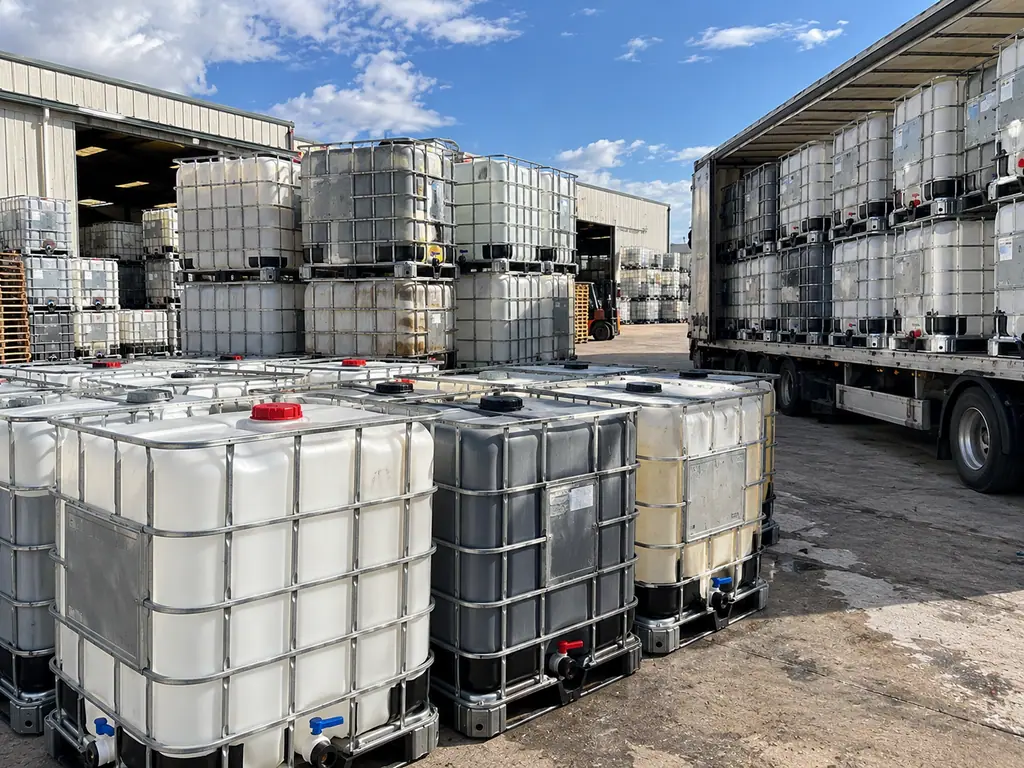
Somewhere in our records there is a cage that has been through this yard eight times. It is the longest-serving unit we can document and it is a useful thing to describe, because it shows what the upper bound of reuse actually looks like.
The life, in brief
- Built in the mid-2000s, steel pallet base, fitted with its original bottle at a packaging plant.
- First commercial service: industrial detergent concentrate, several years, same customer.
- First arrival here: cage straight, bottle stained but sound. Washed, new valve, resold.
- Second life: liquid fertilizer on a farm in Ohio, outdoors, which is where it picked up most of its UV damage.
- Returned with a yellowed bottle. Rebottled — first new bottle, cage straightened and re-footed.
- Third and fourth lives: water treatment polymer, indoors, two different customers.
- Returned with a bowed lower tube. Pressed, welded, back out.
- Fifth life: brine for a municipal crew.
- Rebottled again after a freeze event cracked the second bottle.
- Sixth and seventh lives: wash water and coolant at a machine shop.
- Eighth: currently in service, on its fourth bottle, with a cage that is nineteen years old.
What kept it alive
Three things, none of them luck. It spent most of its life indoors, so the cage never sat in standing water. It was handled by people who approached square, because the frame has no mast damage. And it went through a yard that separated the bottle from the cage instead of treating the unit as one object.
The arithmetic
| Measure | This cage | A new tote each time |
|---|---|---|
| Cages manufactured | 1 | 8 |
| Bottles manufactured | 4 | 8 |
| Steel used | 48 kg | 384 kg |
| Virgin HDPE used | 82 kg | 164 kg |
| Approx. CO₂e | ~245 kg | ~1,090 kg |
Roughly 845 kg of CO₂e that did not happen, from one ordinary cage that nobody treated as special at any point.
Why we are not claiming this is typical
It is not. The mean across our records is 5.8 loops and 1.9 bottles per cage. This unit is at the far end of the distribution, and the reason it got there is a combination of indoor storage and careful handling that most fleets do not achieve.
What it does show is the ceiling. When people ask whether a used tote is a compromise, the honest answer is that a well-handled cage outlasts most of the equipment around it, and the only consumable in the system is a 20 kg piece of plastic.