Livonia, Michigan · circular by default since 2009
Totes that
refuse
to die.
An IBC tote is 150 pounds of good engineering. Most of them get used once. We buy them back, wash them out, re-cage them, re-sell them, haul them, and when a bottle is genuinely finished we granulate it and start again. Reuse first — recycling is the last resort, not the headline.
Diverted to date
412k
totes kept out of landfill
Loops per cage
5.8
average across our fleet
Reused, not remade
94%
of intake returns to service
HDPE recovered
1.9k t
granulated instead of buried
Steel kept in use
3.4k t
cages repaired, not scrapped
CO₂e avoided
46k t
modelled, methodology published
Cumulative figures since 2009, modelled with the factors published on our carbon math page. We would rather show the arithmetic than a green leaf.
The five-stage loop
A landfill is just a
warehouse nobody
ever unlocks.
Here is the actual path a tote takes through our yard. No stage is skipped, and stage five is the one we try hardest to avoid.
Collected
We pick empties up from plants, farms, breweries and distributors — or you drop them at Livonia. Nothing is scheduled for landfill until a technician has said so.
Triaged
Every cage is logged, photographed and graded within 24 hours of intake: bottle clarity, weld integrity, foot rust, valve threads, last-contents paperwork.
Reconditioned
Triple rinse, caustic or steam depending on what was inside. New valve, new gasket, cage straightened, feet re-welded, passport ID stencilled.
Returned to service
Graded, priced and shipped. A healthy cage comes back to us again and again — we have units on their eighth loop.
Recycled, finally
When a bottle is genuinely finished it is cut, washed, granulated into HDPE regrind. Steel goes to the mill. The loop closes, and reopens.
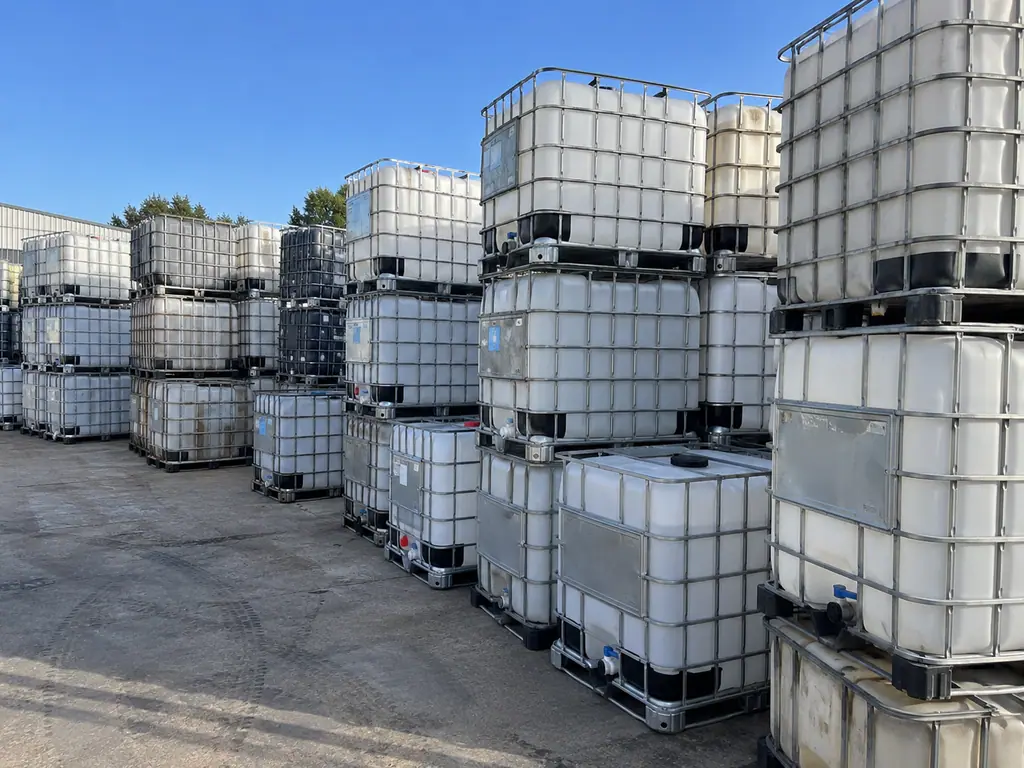
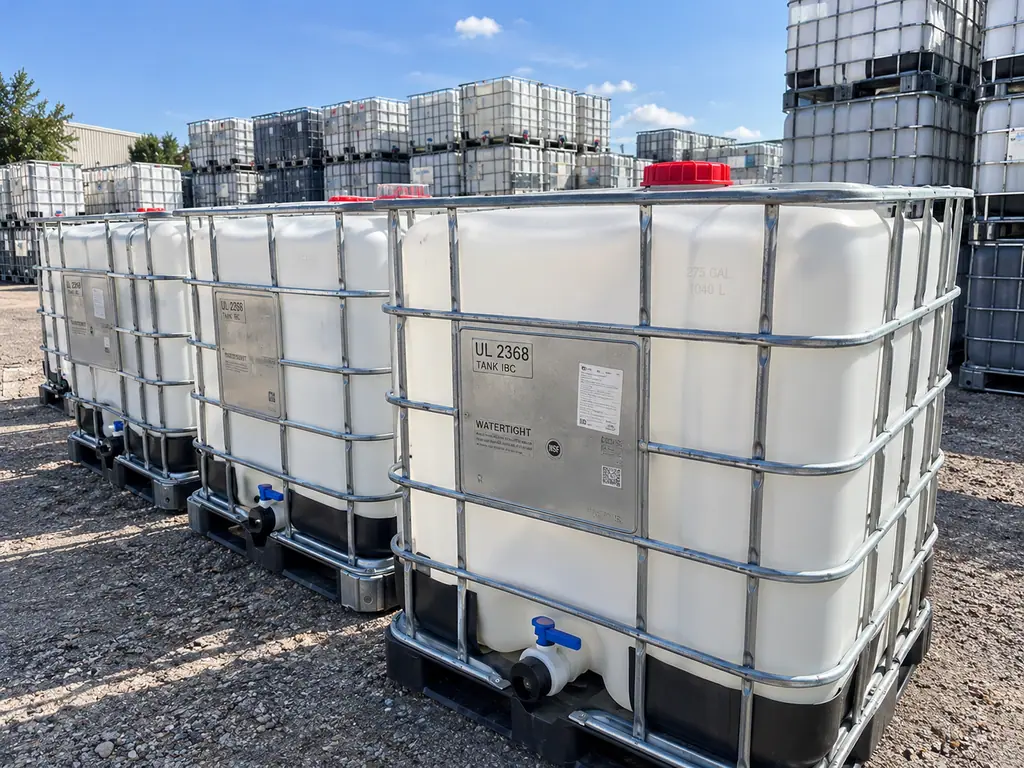
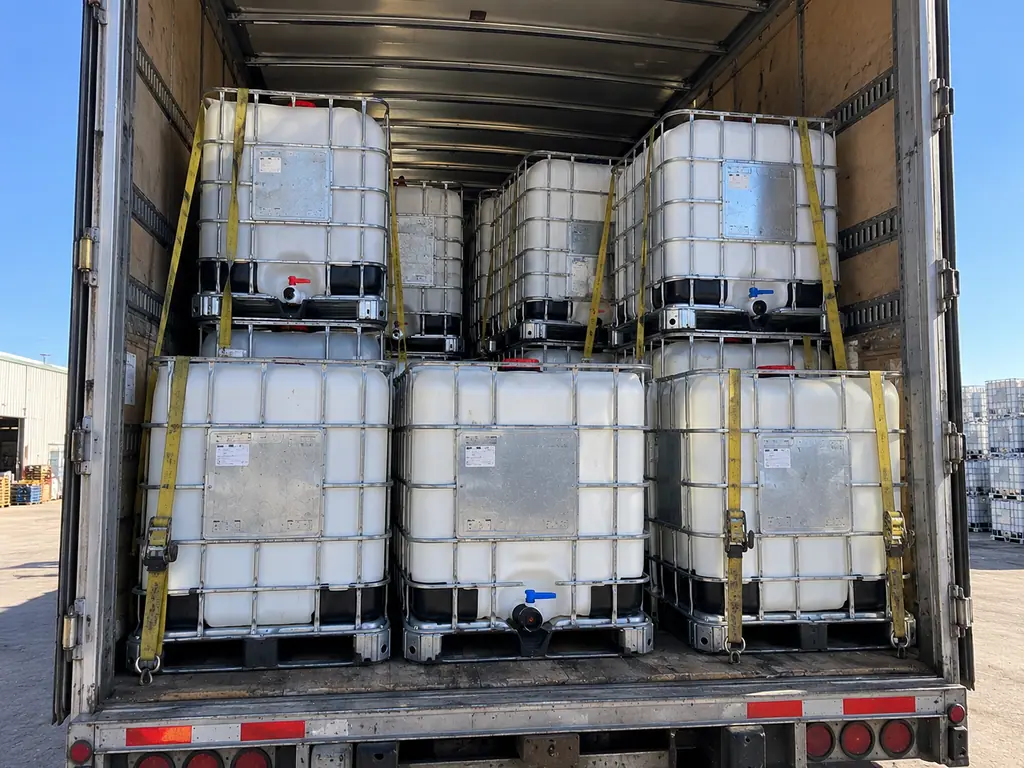
The yard, as it actually looks
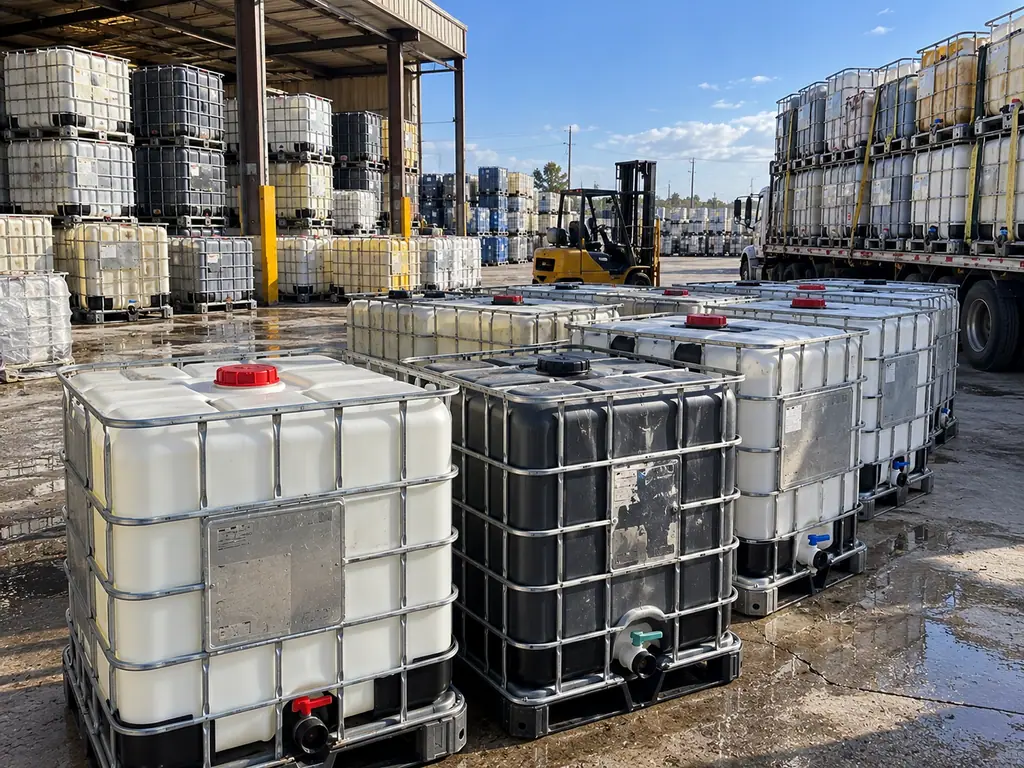
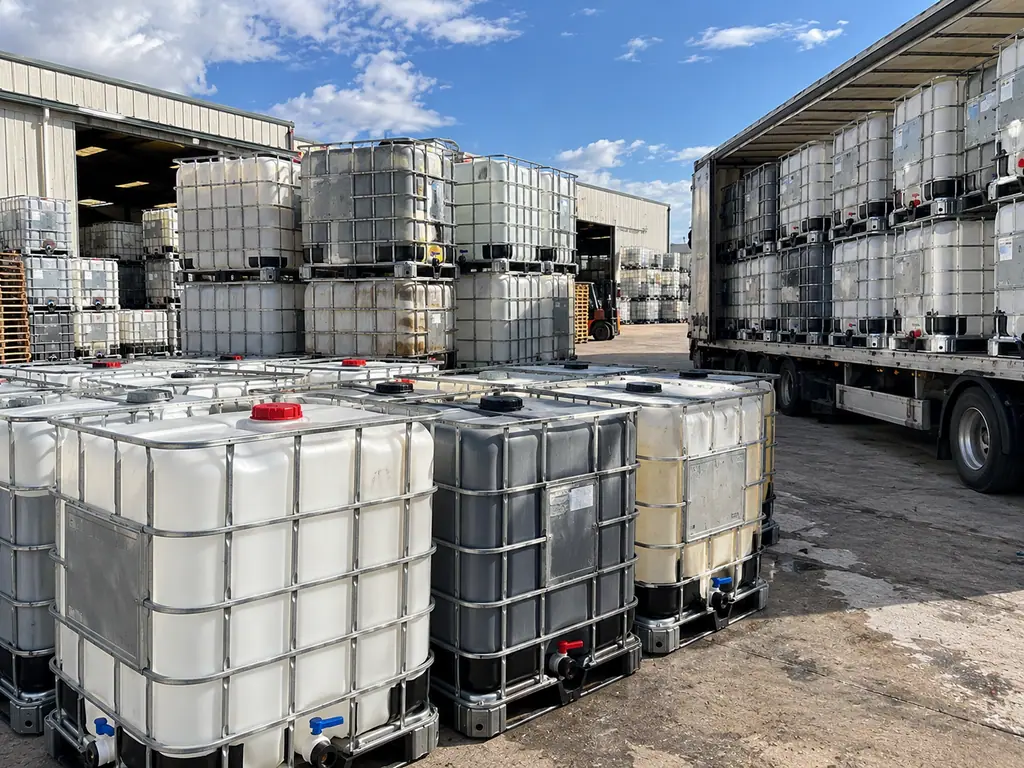
Four acres of somebody else's empties
No stock photography and no renders here — these are our own cages, on our own apron, in the condition they arrive and leave in.
Six things we do with one object
Buy. Sell. Wash. Haul. Recycle. Rebuild.
Most suppliers pick one of these. Running all six is what lets us keep a cage in service for a decade instead of a season.
We buy your totes
Empty cages taking up your yard are inventory to us. Tell us grade, quantity and last contents and you get a cash number — not a disposal invoice.
Open →We sell reconditioned
Washed, leak-tested, valve-replaced 275 and 330 gallon totes, graded honestly and photographed before they ship.
Open →We recondition
Three-stage wash line, caustic and steam options, cage straightening, re-footing, gasket and valve replacement, stencilling.
Open →We haul
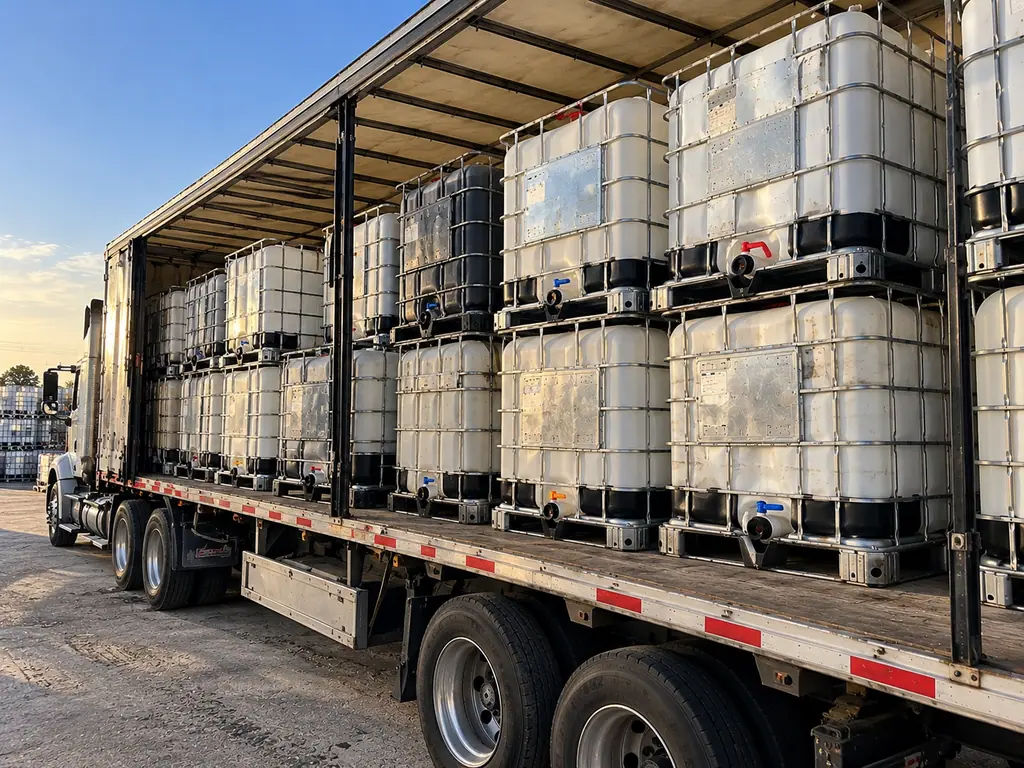
Our own flatbeds and vans across MI, OH, IN and southern Ontario. Partner carriers for the lower 48. Loads of 4 to 44.
Open →We recycle what's done
Cracked bottles become granulated HDPE regrind. Dead cages become steel scrap. Almost nothing reaches a landfill.
Open →We build new things
Rain harvesters, aquaponics beds, planters, livestock waterers, flood barriers, dock floats — fabricated from cages we rescued.
Open →Ecology is the product, not the marketing
Every reused tote is
112 kg of CO₂e
that never happened.
Making a new 275-gallon tote means ~20 kg of virgin HDPE, ~48 kg of new steel, and the energy to form both. Washing an existing one costs a few dozen litres of water and some heat. That gap is the entire reason this company exists.
- Reuse beats recycling by roughly 4× on embodied carbon.
- Closed-loop wash water: filtered, reused, then treated before discharge.
- Backhauled freight — empties ride home on trucks already going that way.
- Zero-landfill target on bottles, cages, pallets and gaskets by 2028.
CO₂e avoided
3,066 kg
Virgin HDPE not made
492 kg
Steel kept in service
1,152 kg
Landfill volume spared
1,104 ft³
- Roughly the annual uptake of 146 mature trees.
- About 0.7 average US cars taken off the road for a year.
- Our wash line uses about 1,008 L for that many totes — already netted out above.
Estimates, openly stated: 20.5 kg HDPE per 275-gal bottle, 48 kg steel per cage and pallet, 1.9 kg CO₂e per kg virgin HDPE and 1.85 per kg virgin steel (cradle-to-gate literature values). Freight is excluded because it depends on your lane — we quote it separately. Full working is on the carbon math page.
The thing nobody else does
Every cage we ship
carries a passport.
A used tote is only as trustworthy as its history. So we stencil an ID on every cage and keep its file: build year, bottle changes, wash chemistry, last contents, loop count, avoided emissions. Type an ID and read it back.
It is the opposite of how used totes are normally sold — a pallet of anonymous cages and a shrug. Ours have paperwork.
Format
330 gal / 1,250 L
Current grade
Rebottled
Cage born
2016
Service loops
6
Bottles fitted
2
CO₂e avoided
672 kg
Road miles logged
1,885
Landfill mass avoided
900 lb
Service history
- 2016Cage pressed and galvanised. First bottle fitted at Fort Wayne, IN.
- 2017First commercial fill — Latex paint base.
- 2019Bottle fatigue flagged at intake. Rebottled with new HDPE; cage straightened and re-footed.
- 2021Triple rinse on our line. Valve and gasket replaced, leak-held for 30 minutes.
- Loop 5Returned empty from Toledo, OH. Cage graded Rebottled.
- NowIn service with a Michigan grower
Cages already in our yard resolve to their real logged history. Any other ID resolves to a modelled one, so you can see the exact fields we keep — build year, bottle changes, wash chemistry, loop count and avoided emissions — before a tote ever reaches your dock.
Size guide, condensed
Two sizes cover 90% of the world
The 275 and the 330 share a 48 × 40 inch footprint — the difference is height, and height is what breaks dock doors and mixer clearances. The full guide goes much deeper.
| Format | Capacity | Footprint | Height | Tare | Notes |
|---|---|---|---|---|---|
| 275 gal caged IBC | 275 gal · 1,040 L | 48" × 40" | 46" – 46.5" | 120 – 140 lb | The industry workhorse. Fits two-wide in a 53' trailer. |
| 330 gal caged IBC | 330 gal · 1,250 L | 48" × 40" | 53" – 59" | 150 – 185 lb | Same footprint, taller bottle. Check door height before ordering. |
| 120 gal caged IBC | 120 gal · 450 L | 40" × 32" | 36" – 40" | 85 – 105 lb | Tight-space option for labs, breweries and mobile rigs. |
| 180 gal caged IBC | 180 gal · 680 L | 48" × 40" | 36" – 38" | 100 – 120 lb | Low profile — good under low-clearance fill lines. |
Knowledge base
We write down what we know
Buying used industrial equipment is mostly an information problem. These are the articles our own crew sends to customers.
Is it really food grade? A 6-point field check
Sellers say 'food grade' a lot. Here is how to verify it in ninety seconds with your own eyes and nose.
Sizing · 6 min275 vs 330 gallon: the decision nobody documents
Same footprint, different height — and that height quietly decides whether your dock, your trailer and your mixer still work.
Ecology · 9 minThe carbon math of reconditioning a tote
We show the whole arithmetic — resin, steel, trucking, washing — instead of printing a green leaf and hoping you don't ask.
Compliance · 8 minUN markings decoded, character by character
31HA1/Y means something very specific. Here is the whole string, translated.
Grades · 5 minWashed, rinsed, rebottled: what each word actually buys you
Four words, four very different interiors, four very different prices.
Reuse · 10 minEleven ways growers put a used tote back to work
From gravity-fed drip lines to calf waterers — field-tested reuses with the fittings you need for each.
Straight answers
The six questions we get every week
Do you actually pay for used totes, or just haul them away?
What is the minimum order?
Can I store drinking water in a reconditioned tote?
How fast can you pick up a load?
Are your totes UN rated?
What happens to a tote you cannot save?
Ready to put a tote back to work?
Send one form. We answer with real numbers — grade, quantity, freight, lead time.