Certifications & compliance
What we can
prove — and what
we won’t claim.
Used-container compliance is where this industry gets slippery. Here is exactly what documentation travels with our totes, who issues it, and which claims we refuse to make about reused equipment.
Request documentation for a specific lotWe send paperwork before payment
Paperwork that ships with the tote
Five documents, every order
| Document | What it states | Issued by |
|---|---|---|
| Last-contents disclosure | The product the bottle held before intake, as supplied by the previous owner, plus our own residue findings | IBC Recycle, signed |
| Wash record | Date, stage sequence, chemistry, temperature and hold time for that specific unit | IBC Recycle wash line |
| Grade sheet | Assigned grade with the inspection notes behind it — bottle clarity, weld state, valve condition | IBC Recycle intake |
| Passport file | Build year, bottle changes, loop count, repairs, cumulative avoided emissions | IBC Recycle, by cage ID |
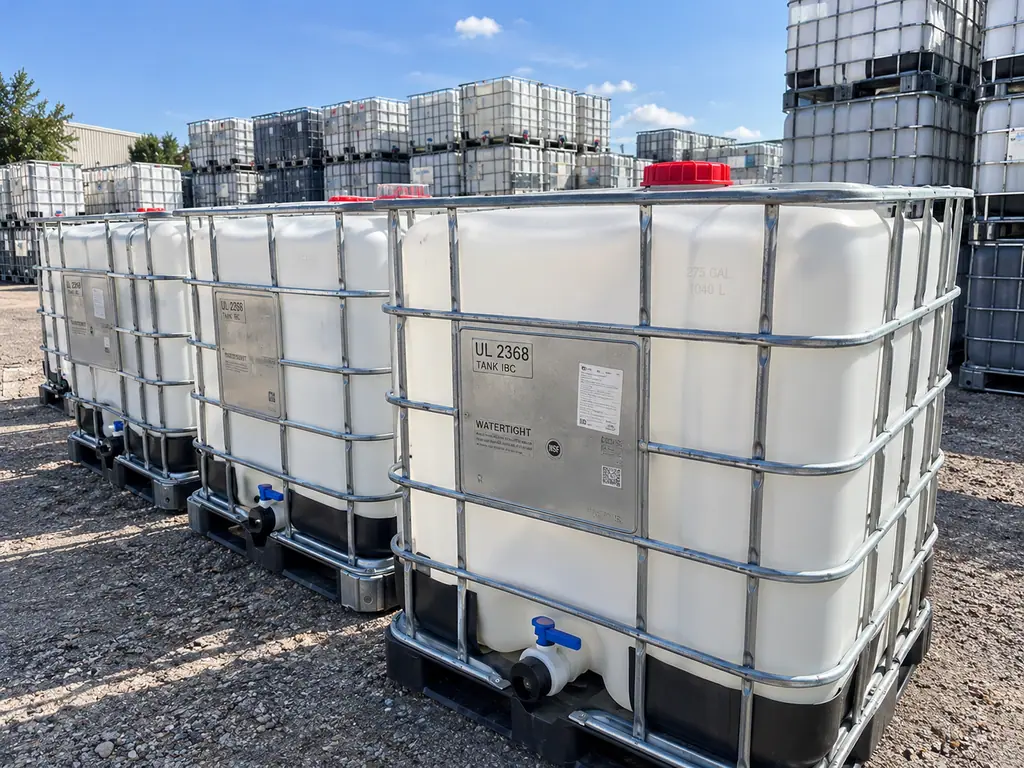
| Photo set | Six-angle photographs taken at intake and after reconditioning, including the marking panel | IBC Recycle |
Regulated work
Where a licensed third party is required
Some things cannot honestly be done in-house, and we do not pretend otherwise.
- UN/DOT recertification. Re-marking a reconditioned packaging is performed under a licensed reconditioner’s registration, with leak testing to the applicable standard. We route that work to a licensed partner and the paperwork carries their registration, not ours.
- Granulation and reprocessing. Bottles we scrap are granulated by a regional reprocessor under a standing agreement. We name them on request.
- Wastewater discharge. Treated wash water is tested by an independent lab before discharge, under our municipal permit.
Claims we do not make
- We never describe a reused bottle as “FDA approved”. The FDA approves materials and processes, not second-hand containers.
- We never call a tote food grade unless its documented history is food-only and it has passed a food-protocol wash.
- We never imply a non-UN tote can ship regulated hazmat.
- We never use the words biodegradable, carbon neutral or eco-friendly about any product we sell.
- We never backdate or reissue a wash record.
Compliance questions we get
Short, direct answers
Can I use your tote for potable water?
In a food-grade or rebottled unit, yes — many of our customers do exactly that for agricultural and emergency storage. Check your state or local requirements for potable storage, and read the last-contents disclosure before you fill it.
Do you provide a certificate of cleanliness?
We provide a wash record, which is more useful: it names the chemistry, temperature and hold time rather than asserting an outcome. If your auditor needs a specific format, send it to us and we will complete it for the lot.
Is the UN marking on the cage still valid?
A marking is valid for the unit as marked, in the condition it was marked. If the bottle has been replaced or the packaging repaired, it requires recertification to carry the rating. We photograph the panel and tell you plainly which case applies.
Can you ship internationally?
We ship across the lower 48 and into southern Ontario. Beyond that, export documentation and used-container import rules vary enough that we will tell you honestly whether it is worth the freight.
Need documentation before you commit?
Ask for the paperwork on a specific lot. We send grade sheets, wash records and marking-panel photos before you pay.