We make a specific claim on this site: reusing a 275-gallon IBC tote avoids roughly 112 kg of CO₂e compared with manufacturing a new one. This article is the whole arithmetic behind that number, including the parts that work against us. If you want to argue with the figure, this page gives you everything you need to do it properly.
What a new tote costs the atmosphere
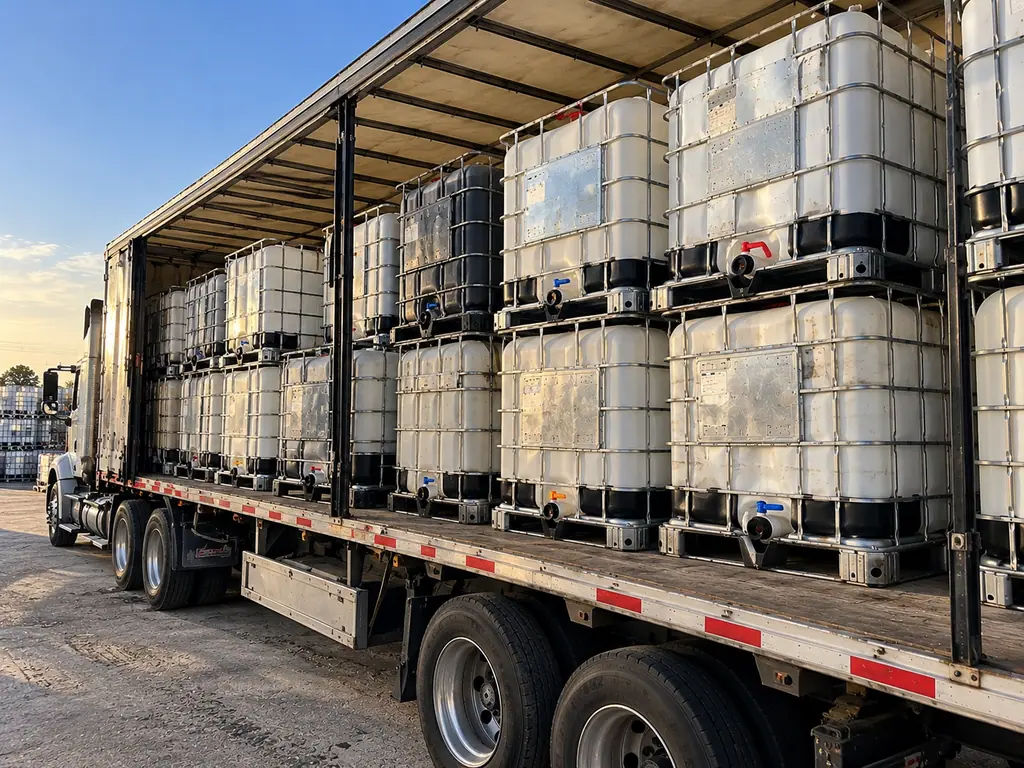
A new caged composite IBC is three things: a bottle, a cage, and a pallet base.
| Component | Mass | Emission factor | Subtotal |
|---|---|---|---|
| HDPE bottle | 20.5 kg | 1.9 kg CO₂e / kg (virgin resin, cradle-to-gate) | 39.0 kg |
| Galvanised steel cage | 36 kg | 1.85 kg CO₂e / kg (virgin structural steel) | 66.6 kg |
| Steel pallet base | 12 kg | 1.85 kg CO₂e / kg | 22.2 kg |
| Assembly, galvanising, packaging | — | estimated allowance | ~8 kg |
| Total, new unit | 68.5 kg | — | ≈ 136 kg CO₂e |
Those factors are mid-range published cradle-to-gate values for virgin HDPE resin and virgin structural steel. Both vary by region and by energy mix — a European electric-arc steel route is considerably better, a coal-heavy blast-furnace route considerably worse. We use mid-range figures deliberately, because picking the most favourable factor is how marketing departments produce numbers nobody can reproduce.
What reuse costs
Washing a tote on our line consumes heat, detergent, electricity and about 42 litres of recirculated water. Allocating our line’s energy consumption across throughput gives roughly 8 kg CO₂e per unit, including the caustic and the drying air.
136 − 8 = 128. So why do we publish 112?
The honest deductions
- Collection freight. A used tote has to be collected. We backhaul 68% of pickups on lanes that were already running, but the marginal fuel is not zero. We allocate about 9 kg CO₂e per unit for collection and redelivery across our typical lane mix.
- Attrition. Six percent of intake cannot be saved. The emissions of collecting and processing those units have to be carried by the 94% that can. That is roughly another 4 kg per saved unit.
- Valve and gasket replacement. New parts, new emissions. Small, but real — about 1.5 kg.
- End-of-life discount. A reused tote still eventually dies, so reuse delays rather than eliminates the end-of-life burden. We apply a conservative haircut for this rather than claiming a permanent avoidance.
Net: ≈ 112 kg CO₂e avoided per reused 275-gallon tote. Round numbers, openly derived, with the deductions visible.
How reuse compares with recycling
| Path | Embodied cost per unit | Versus new |
|---|---|---|
| Reuse as-is | ≈ 8 kg CO₂e | 94% avoided |
| Rebottle (new bottle, reused cage) | ≈ 47 kg CO₂e | 65% avoided |
| Recycle (granulate and re-melt) | ≈ 78 kg CO₂e | 43% avoided |
| Landfill | 136 kg wasted, plus the hole | 0% avoided |
This is the entire reason we describe recycling as a fail-safe rather than an achievement. Recycling recovers material but still pays most of the manufacturing energy over again. Reuse skips it.
What this number is not
It is not a life-cycle assessment. It is not third-party verified. It excludes your freight, because your lane is yours and we quote it separately rather than hiding it in an average. It uses mass-balance arithmetic and published factors, which is appropriate for a procurement decision and insufficient for a regulatory disclosure.
If you need something more rigorous for a corporate report, tell us and we will send you the spreadsheet with our actual throughput and utility data so your own analyst can rebuild it. We would rather be checked than believed.
You can run your own quantities through the impact calculator, which uses exactly these factors.