Chapter 07 · Stacking & storage
Three rules
our drivers
never break.
A tote failure is almost never a surprise. It is a cage that was stacked wrong, a bottle that spent four summers in the sun, or water left in a bottle through a Michigan January.
The three rules
Memorise these and you will never have an incident
Never stack a filled tote in transit
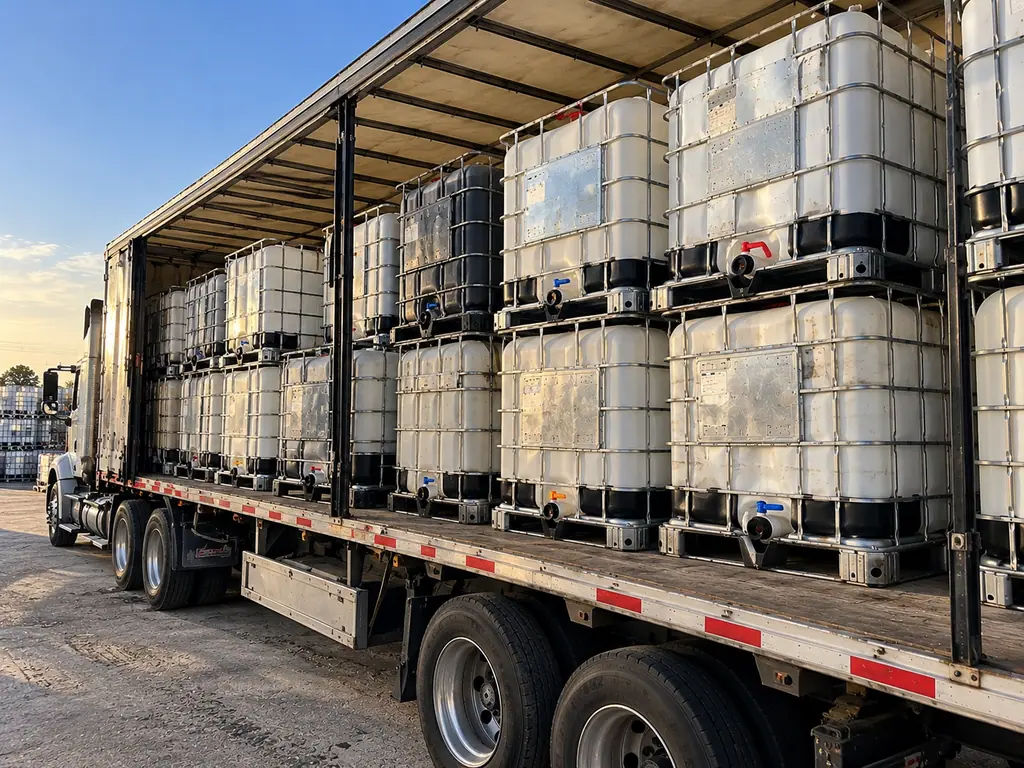
Road movement plus a flexing bottle equals an unstable stack. Empties stack three high on a trailer; filled units travel single, every time, regardless of what the cage rating says.
Never stack on a damaged cage
The cage carries the entire stack load, not the bottle. One bowed tube or one failed weld in the lower unit and the whole column is compromised.
Never stack across different formats
A 330 on top of a 275 does not land its feet on the lower cage’s load path. Same format, same pallet type, square on the feet — or do not stack.
Stacking limits
What is actually safe
Cage ratings vary; this is how we work in our own yard, which is deliberately more conservative than the nameplate.
| Situation | Our limit | Nameplate often says | Why we are stricter |
|---|---|---|---|
| Empty, washed, sound cages, static | 3 high | 4 high | Yard forklift traffic and wind loading on the top unit |
| Empty in transit | 2 high, strapped | 3 high | Road dynamics and strap tension on the lower cage |
| Filled, static, on level concrete | 2 high | 2 high | Bottle creep over weeks of sustained load |
| Filled, in transit | Never | Sometimes permitted | We have seen the failure mode. We do not do it. |
| Filled, in a pallet rack | Per the rack, 1 per bay | — | The rack rating, not the tote, is the limit |
| Mixed formats | Never | — | Feet do not land on the load path |
Outdoor storage
Four things the weather does
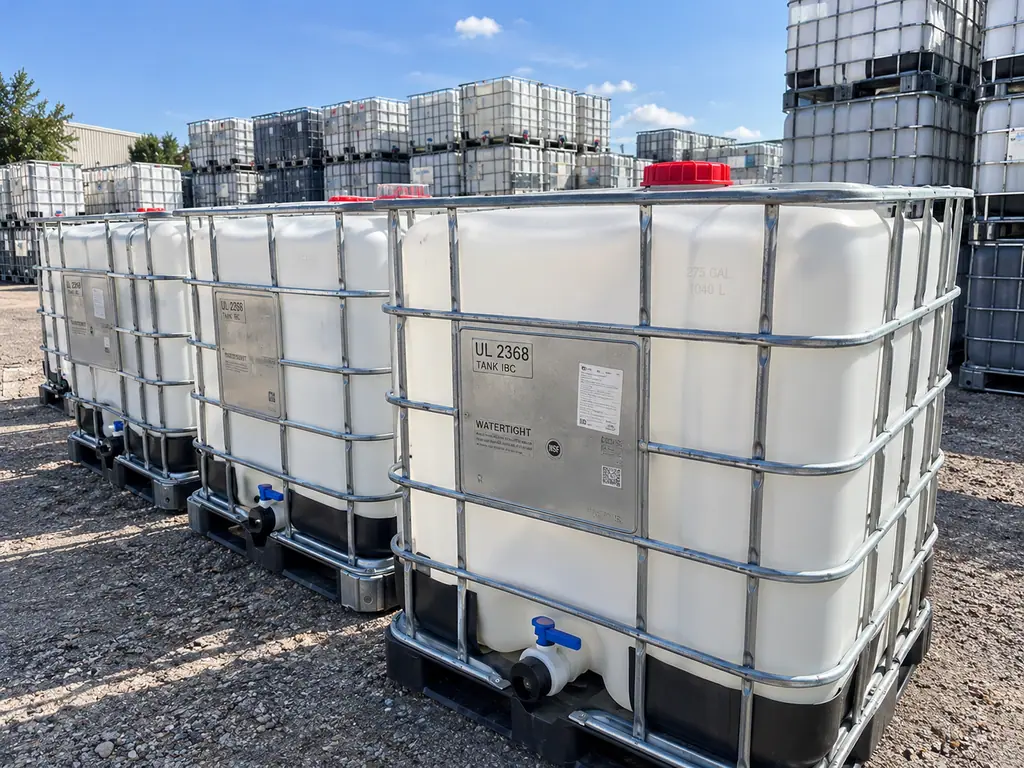
Totes live outside all over the Midwest and do perfectly well — if you plan for these.
Freeze expansion
Water expands roughly 9% when it freezes. A full bottle will bulge, deform its cage and sometimes split. Drain to two-thirds before winter, or heat and insulate.
UV degradation
Bare natural HDPE yellows, clouds and gradually embrittles under sunlight. A cover, a shade frame or an opaque wrap roughly doubles bottle life.
Thermal breathing
A sealed bottle in full sun pressurises by day and goes into vacuum at night, which deforms the walls over time. Fit a gasketed vent plug.
Algae and insects
Light plus standing water plus nutrients equals algae in weeks, and an open fill port is a mosquito nursery. Screen the port and block the light.
Siting
Where to put it
- Level, firm ground: concrete, pavers or compacted gravel
- Never on a wooden deck or soft soil — a full 275 is over 2,400 lb
- Forklift or pallet-jack access on at least one side
- Away from vehicle traffic paths, or protected by a bollard
- Secondary containment where your product or local rules require it
- Outlet accessible without crawling under the cage
If you store anything other than water, check whether you need secondary containment. A spill pallet sized for one or two totes costs far less than a remediation visit, and we stock them.
Spill pallets & stands →Storage questions
Practical answers
How long can product sit in a tote?
Can I bury a tote as a cistern?
Can I pressurise it to push product out?
Can I stack them two high in my warehouse racking?
Do I need to wash before refilling with the same product?
Ready to put a tote back to work?
Send one form. We answer with real numbers — grade, quantity, freight, lead time.