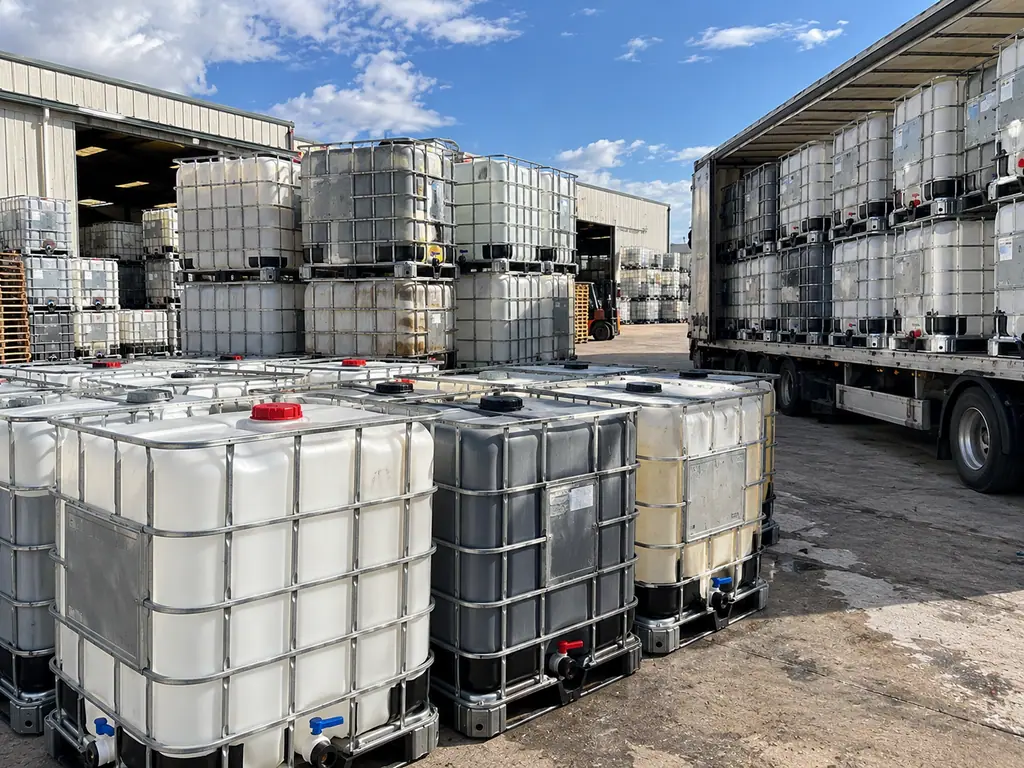
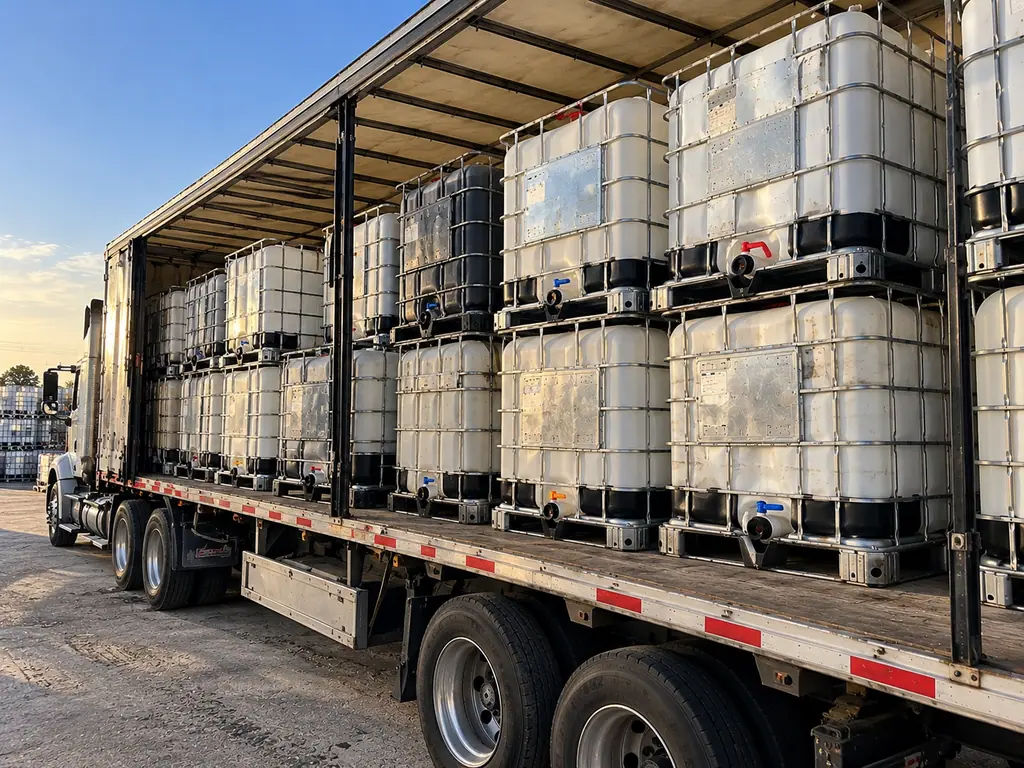
A new HDPE bottle is a slightly soft rectangle with flat walls and crisp shoulders. Everything that happens to it afterwards shows up as a change in that shape, and the shape of the change tells you the cause. Our graders use five categories.
1 · Shoulder sag
The top third of the bottle has settled, giving the shoulders a rounded, slumped look, and the fill port sits slightly lower than the cage rail suggests it should.
Cause: sustained stack load while full. HDPE creeps under constant stress — it does not spring back. The wall at the shoulder is now thinner than it was. These units go down a grade, and we do not sell them for anything stacked.
2 · Mid-wall barrel
The middle of each long wall pushes outward in a smooth, even curve, as if the bottle had been inflated slightly. Often the cage shows corresponding polish marks where the wall has been pressing on the tubes.
Cause: repeated filling with a dense product, usually above 1.2 specific gravity, in a cage rated for water. The bottle has been doing structural work that the cage was supposed to do. Still serviceable for light duty; never for dense product again.
3 · Vacuum dimple
One or more concave dents, often with sharp edges, that look as though somebody leaned on the bottle with a knee.
Cause: the bottle was sealed hot and cooled, or sealed and then the contents were pumped out faster than air could enter. A vented cap would have prevented it. Dimples that pop back out when the bottle is refilled are cosmetic; dimples with a visible crease line have cold-worked the plastic and are not.
4 · Freeze bloom
A generalised swelling, often with whitened stress marks radiating from the corners, and frequently a cage that is now slightly out of square.
Cause: water left in the bottle through a freeze. Ice expands about nine percent and the bottle takes all of it. We scrap most of these. The giveaway is the cage: freeze damage pushes the frame, and frame damage from the inside is distinctive.
5 · Base spread
The bottom of the bottle has spread out over the pallet deck, sometimes with a visible lip hanging past the frame.
Cause: long storage, full, on a surface that was not flat, usually combined with heat. The base is the thickest part of the bottle so this takes years. When you see it, the unit is old and its remaining life is short.
| Bulge | Cause | Our verdict | Can you still use it? |
|---|---|---|---|
| Shoulder sag | Stacked while full | Grade down | Yes — never stacked |
| Mid-wall barrel | Dense product | Grade down | Yes — water or light duty only |
| Vacuum dimple, no crease | Sealed and cooled | No change | Yes — fit a vented cap |
| Vacuum dimple, creased | Cold-worked plastic | Grade down hard | Non-contact use |
| Freeze bloom | Water frozen inside | Scrap | No |
| Base spread | Years of load and heat | Scrap or last use | One more job, maybe |
Why this is worth learning
Because bulge is the only honest indicator of remaining life on an HDPE bottle, and remaining life is the thing a used-tote listing never states. Clarity tells you about UV. Smell tells you about residue. Shape tells you about the future.