Plenty of products settle, separate or need blending before use, so mixing inside the tote is a normal requirement. We see four approaches at customer sites and only two of them leave you with a tote afterwards.
Approach 1 · Through the fill port — correct
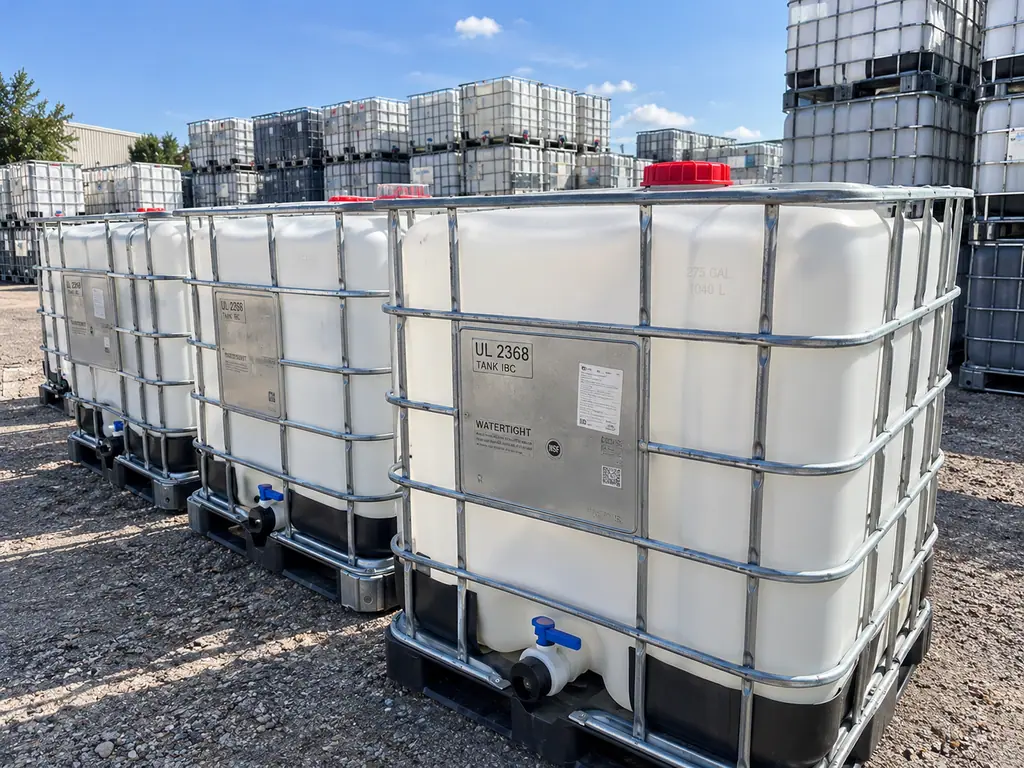
A folding or collapsible impeller on a shaft, inserted through the 6-inch DN150 port, driven by a clamp-mounted air or electric motor. Nothing is modified. The mixer moves between totes. The port cap goes back on afterwards.
This is the right answer in almost every case, and the folding impellers available now handle most viscosities we encounter.
Approach 2 · Recirculation through the outlet — also correct
A pump takes from the 2-inch outlet and returns through the fill port, with the return pipe angled to create rotation. No modification, no shaft seal to fail, and it doubles as your transfer pump.
Slower than an impeller and excellent for anything that merely needs re-homogenising rather than genuine shear.
Approach 3 · A hole in the lid — tolerable
Drilling the screw cap, not the bottle, to pass a shaft. The cap is a consumable that costs a few dollars, so this modifies nothing that matters. Use a gland or a bush and expect the cap to be a wear item.
Approach 4 · A hole in the bottle — the end of the tote
Every month somebody asks us to fit a side-entry mixer, a sight glass, or a second outlet by drilling the bottle wall. We decline, for three reasons.
- HDPE bottle walls are thin and unreinforced away from the moulded fittings. A penetration becomes a stress concentration, and a full tote applies real pressure at the base.
- Any penetration needs a seal that lives in your product for years. Bulkhead fittings in a flexing wall work loose. We have seen the aftermath.
- It permanently removes the unit from resale, from food service and, if it carried one, from its UN marking. A $40 fitting writes off a $300 asset.
Choosing by product behaviour
| Product behaviour | Recommended approach | Note |
|---|---|---|
| Light settling, e.g. pigment | Recirculation | Twenty minutes before dispensing |
| Separation, e.g. emulsions | Folding impeller | Needs shear, not just motion |
| Crystallisation, e.g. UAN cold | Warm first, then impeller | Mixing cold product breaks shafts |
| Sludges and solids | Plug valve and recirculation | Butterfly valves jam on solids |
| Shear-sensitive polymers | Slow recirculation only | An impeller will damage the product |
If you are mixing routinely, tell us at order time. We will supply the cap, the bracket and the right outlet valve as part of the order instead of leaving you to improvise a mount three weeks later.